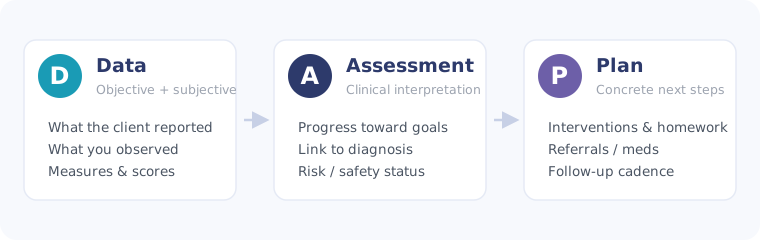
Key takeaways: A DAP note organizes a session into three parts — Data (what happened or was observed), Assessment (what it means clinically), and Plan (what’s next). It’s a faster alternative to SOAP because it merges the subjective and objective into a single Data section. Below are the format, a worked example, a copy-paste template, and the common mistakes to avoid.
DAP stands for Data, Assessment, and Plan — a structured progress-note format used widely by therapists, counselors, and other behavioral health clinicians to document a session clearly and defensibly. DAP notes are popular because they’re quick to write while still capturing everything a clinical record (and an insurer) needs.
Why is the DAP note format popular?
The DAP format is popular largely because it is quick to complete. Its three sections keep documentation focused and flexible, group all observations in one place, and map cleanly onto how clinicians think about a session — making it a practical choice for busy direct-care staff who need defensible notes without a long template.
The DAP note format, section by section
D — Data
The objective, observable record of the session: what the client reported, what you observed, and any measurable data. Stick to facts, not interpretation. Include direct quotes where useful and screening scores when available.
Examples of what goes here: the client’s presentation and behavior, reported symptoms, direct quotes, PHQ-9/GAD-7 scores, attendance, and engagement.
A — Assessment
Your clinical interpretation of the data. Connect what you observed to the diagnosis and the treatment plan: Is the client improving, worsening, or stuck? Does today’s session support the current approach or argue for a change? This is where your clinical reasoning lives.
P — Plan
The concrete next steps: interventions, homework, referrals, medication changes (if within scope), the focus for next session, and the follow-up cadence.
What does the D in a DAP note stand for?
The D in DAP stands for Data — the first of the three sections: Data, Assessment, Plan. The Data section records the objective and subjective information from the session: what the client reported, what the clinician observed, and any measurable indicators, before any interpretation is added.
A worked DAP note example
The following is an illustrative example for format guidance, not clinical advice.
Data: Client arrived on time, appeared tired but well-groomed, maintained appropriate eye contact, and engaged readily. Reported improved sleep (7–8 hours nightly) and appetite returning to normal. Stated, “I’m finally able to focus at work again.” PHQ-9 decreased from 15 to 9 over the past month.
Assessment: Client demonstrates measurable improvement in depressive symptoms consistent with treatment goals; the PHQ-9 movement (15 → 9) indicates a shift from the moderately severe to the mild range. Continued response to the current cognitive-behavioral approach; no current safety concerns reported or observed.
Plan: Continue weekly CBT sessions. Assign behavioral-activation homework (schedule two pleasant activities before next session). Re-administer PHQ-9 in two weeks. Next session to focus on relapse-prevention planning.
DAP note template
Copy-ready and free to use — fill each section in order:
DATE: ____   CLIENT ID: ____   SESSION #: ____   CPT: ____

DATA
- Presentation/behavior:
- Client report (incl. quotes):
- Measures/scores (PHQ-9, GAD-7, etc.):

ASSESSMENT
- Progress toward goals:
- Clinical interpretation / diagnosis link:
- Risk (SI/HI/safety) — state explicitly, even if denied:

PLAN
- Interventions used / homework assigned:
- Referrals / medication notes (if applicable):
- Focus for next session & follow-up cadence:
DAP vs SOAP — which should you use?
Both are valid. SOAP (Subjective, Objective, Assessment, Plan) splits the client’s report from the clinician’s observation; DAP merges them into one Data section, which can cut writing time. Many behavioral health clinicians prefer DAP for talk-therapy sessions and SOAP for medical or medication-management visits.
Common DAP note mistakes
- Putting interpretation in the Data section. Keep Data objective; reasoning belongs in Assessment.
- Skipping an explicit risk statement. Document SI/HI/safety status every session, even when denied.
- A vague Plan. “Continue therapy” isn’t enough — name the intervention, homework, and follow-up.
- Notes that don’t support the billing code. Make sure the documentation matches the CPT code and shows medical necessity.
Write DAP notes in seconds with AI
Writing a defensible DAP note after every session adds up. TasiPsych generates a structured DAP note from your session automatically, then checks it against 40+ audit rules — including whether a risk statement is present and whether the note supports the billing code. BAA included, 10-day free trial, no credit card required.
Want the full picture of how AI documentation works for behavioral health? See our Features and transparent Pricing.
Frequently asked questions
What does DAP stand for in therapy notes?
Data, Assessment, and Plan.
What's the difference between DAP and SOAP notes?
SOAP separates subjective and objective information into two sections; DAP combines them into a single Data section, which is usually faster to write.
Are DAP notes acceptable for insurance?
Yes, when they clearly document medical necessity and support the billing code. The Assessment and Plan sections are key for demonstrating that.
How long should a DAP note be?
Long enough to capture the data, your clinical reasoning, and the plan — typically a few concise paragraphs. Clarity matters more than length.
Can AI write DAP notes?
Yes — tools like TasiPsych generate a structured DAP draft from the session for you to review and edit, and can flag missing elements such as a risk statement.
What does the D in a DAP note stand for?
The D in DAP stands for Data. It's the first of the three DAP sections — Data, Assessment, Plan — and holds the objective and subjective information from the session (what the client reported and what the clinician observed) before any clinical interpretation is added.
Why is the DAP note format popular?
The DAP format is popular mainly because it is quick to complete. Its three sections keep notes focused and flexible, group all observations in one place, and match how clinicians naturally summarize a session, which makes it practical for busy direct-care staff who still need defensible documentation.
What is a DAP note template?
A DAP note template has three labeled sections: Data (objective and subjective observations from the session), Assessment (clinical interpretation and progress toward goals), and Plan (next steps, interventions, homework, and follow-up). Clinicians fill each section in order to produce a complete progress note.